One warm winters day in June of 2023, 5 little words became a defining moment in changing my entire view and understanding of connection and community.
After one of our usual excursions to ‘our park’, a parent of one of our children lingered for a chat while collecting his daughter in the afternoon. As we were sharing information with him about his daughter’s day, he asked a question that was very strange. “Did you see a goblin?” he asked with a grin.
We all stared at him blankly. Did he just say goblin? What on earth was this dad talking about?
He quickly realised we knew nothing about this goblin and so turning to his daughter he said, “Go on, tell your teachers there is a goblin in the park and how to find it”. That moment began an unexpected journey, a journey that reminds us just how powerful real connection can be and how opportunities for real authentic community engagement are truly everywhere just waiting to be noticed and snapped up.
A Hidden Story in the Stone.
The moment we told the children that there was a goblin carved into a rock at their park, a quiet hum of excitement spread through the group. Suddenly, our familiar walking path held a special secret, a mystery that was waiting to be found. With maps drawn and the children’s hearts full of anticipation, we set out to our park once more but this time things were different, we were on an adventure. We had become a small band of explorers chasing whispers of a magical creature, that folktale said, lived in the stone.
It felt like a real life treasure hunt as we followed the map – cross the bridge, turn right, go off the track, walk through the long grass, duck under the low hanging tree branches and look for the big rock. That’s exactly what we did when suddenly…we found it, there really WAS a goblin in the stone. It was no bigger than a dinner plate, carved deep into an enormous boulder.
The children were speechless for a moment as they took in the magic. They were completely spellbound, and it took the sound of one of the children letting out an almighty ‘WOAHHHH’ to snap them all out of it. They all crouched low, tracing the rough, cold grooves of its face with their small fingertips, eyes wide with questions that I couldn’t answer fast enough.
“Kate, how old is it?”
“Kate, how did it get there?”
“Kate, WHAT IS A GOBLIN ?”
In that moment, crouched together around a piece of mystical hidden art, in the middle of the bush, it felt like time stood still. What began as an ordinary park visit had transformed into a shared search for story and for meaning. It wasn’t just about art or nature anymore; it was about connection, imagination, and the simple magic in finally noticing what had been there all along.
And that’s where real pedagogy begins. It’s not in a parent wanting their child to write their name, it’s not in the outcomes or the developmental checklists, it all begins with wonder and as teachers and educators it is our job to see those precious moments, hold them gently in our hands and follow where they lead.
Later that night inspired by the children’s fascination in the goblin I wondered if I could find out more about its history and so I posted the question in a local Facebook group. Within hours, the post lit up with responses from neighbours reminiscing, locals tagging friends, and others like me who were curious to learn more. And then, the kind of serendipity that only happens when community and curiosity intersect: a message from a woman who knew the creator of the goblin offering to put us in touch. How joyous this was going to be when I could tell the children I had found the person who had made their goblin.
It was connection, once again, doing its quiet, powerful work.
The Day Gary came to Preschool.
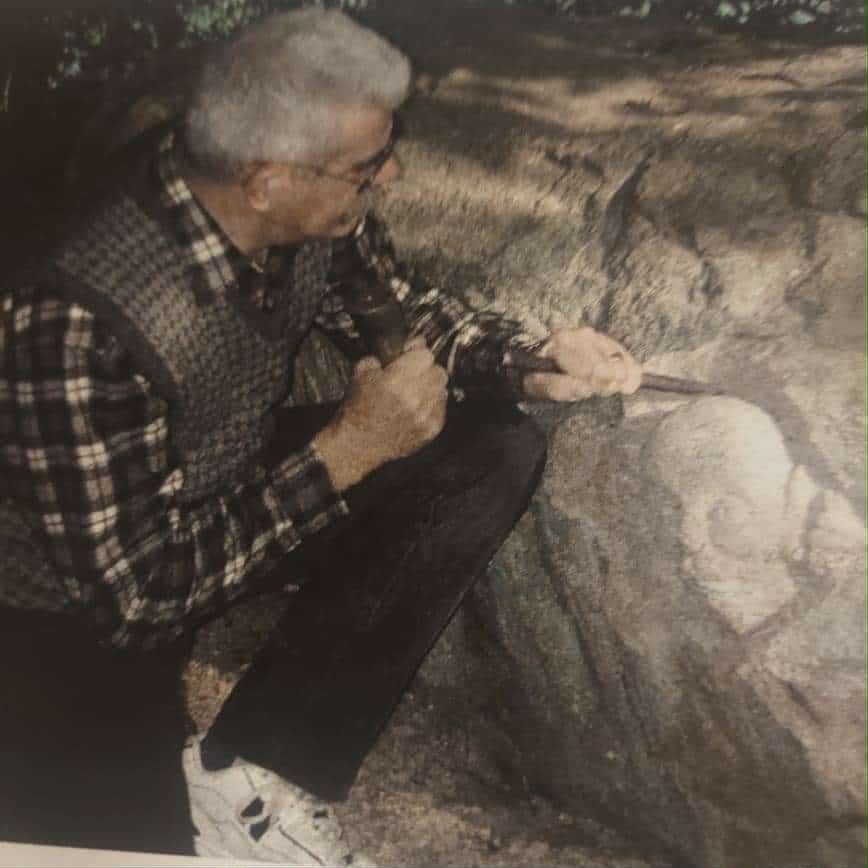
The next day, I received a phone call from Gary, a local elderly man who was the artist behind Goblin Rock and he had been living his life only 2 streets away from our preschool for the last 25 years. He was thrilled that his work had sparked such joy for the children and eagerly agreed to visit our preschool in a few days’ time and in the meantime, he was going to email me a photo that he guessed might have been about 20years old, of himself creating the goblin.
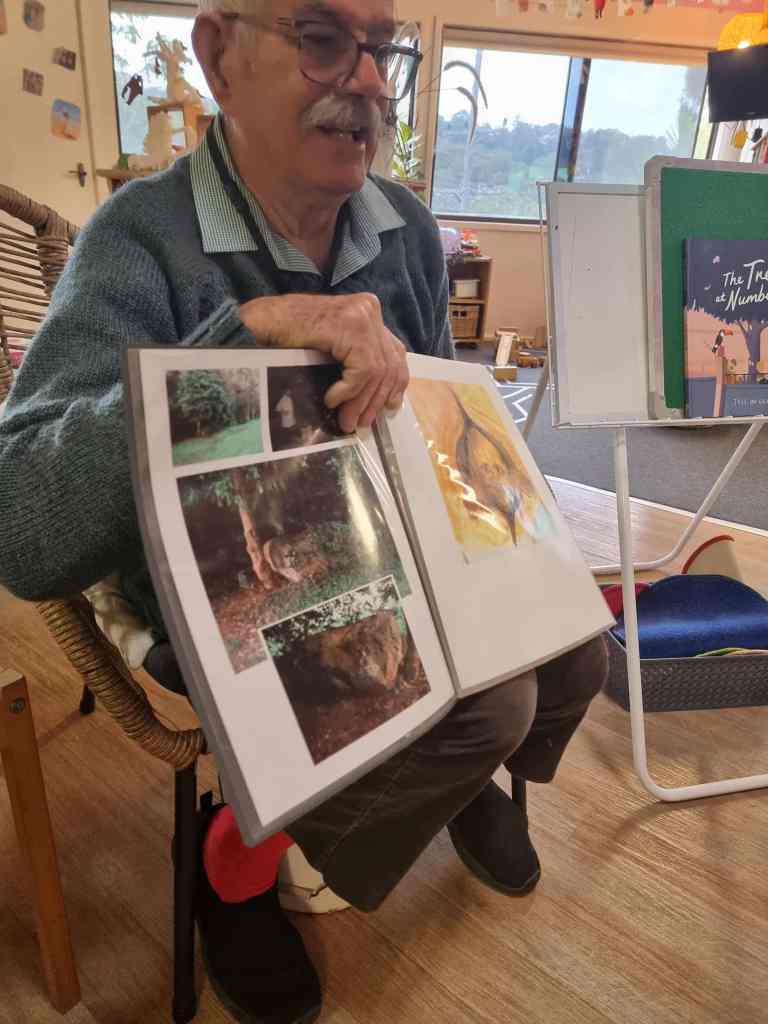
When visiting day arrived the children had an entire wonder wall of burning question’s they needed answers to. Not only did Gary answer all those questions he had also brought with him his original goblin sketch, progress photos, and the very tools he had used to create the goblin. He handed out the tools for the children to touch, each child holding those tools in awe, like it was a long-lost precious artefact. Gary shared how the idea for the Goblin had been born from walking the same track daily and noticing the natural shape of the rock.
“The Goblin was already there,” he told the children with a twinkle in his eye, “I just helped him appear.”
As Gary then demonstrated his carving process, the children watched in silence, their eyes wide, their bodies leaning forward, fully absorbed. I vividly remember thinking this was so much more than an art demonstration. It was relationship in action.
Leading into Garys visit the children had created endless paintings of the goblin that hung proudly within our preschool honouring this now shared story. Gary was lost for words as he slowly took in each artwork made by the children and as he finished he thanked me for finding him and mentioned he thought the magic of the goblin had died years ago. To this day I still believe Gary left our preschool with tears in his eyes.
And the Goblin’s magic didn’t stop there. Families began visiting Goblin Rock on the weekends sending family photos back to preschool for their child to share and total strangers continued to comment on my original Facebook post wanting to know the outcome of the ‘hunt for the goblin rock artist’. I even received emails from parents saying ‘Goblin was a hot topic of conversation at the dinner table again last night, remind me how to find it ?”.
That one day in June, that one simple question from a parent had now allowed relationships to form between the children, their families, a local artist, and even the broader community.
Connection as Curriculum.
Authentic connection transforms learning from an activity into an encounter. The journey that had unfolded exemplifies what the Early Years Learning Framework (EYLF V2.0) describes as ‘Belonging, Being, and Becoming’. That goblin had allowed our children to feel a sense of belonging to their community which allowed them to engage in deeper learning that was not just about the world, but about their place in the world. Goblin rock was not a lesson in art, but about co-constructing knowledge alongside their community members.
As Bronfenbrenner’s Ecological Systems Theory reminds us, a child’s development is deeply influenced by the layers of environment surrounding them. Its family, educators, and community and when these layers interact harmoniously children thrive within a web of meaningful relationships.
The Ripple Effect of Connection.
What began as a local mystery soon grew into a series of authentic partnerships. Just one of the many relationships that has formed from Gary’s visit is our friendship with our local Landcare group, who continue to share with us their knowledge about the park’s flora, fauna, and conservation efforts. Only recently we were invited to their 30thanniversary celebrations where we presented the group with a collaborative art piece designed and made by the children and after the ceremony the children had time to meet and discuss their love of the park with the Newcastle Lord Mayor. Our children were being viewed by our community as active citizens, their voices deserving to be listened to, heard and respected.
What a win.
The children now see their park not just as a play space, but as a living ecosystem filled with stories, responsibilities, and relationships.
This is what community engagement looks like when it’s real. It’s not a scheduled dinosaur show that you book to visit your service or a one off visit from the local fire brigade so that you can take a photo of each child sitting in the truck and label it as learning. It’s an ongoing conversation between children, educators, and the people in the community who share space together.
What the Children Learnt (and What We Did Too).
Through Goblin Rock, the children learnt far more than how stone sculptures are made. They discovered that art could tell a story, that stories connect people, and that every question is an invitation to learn more. They saw that their voices and curiosities matter, that they could reach out, ask questions, and be met with generosity from the adults in their community.
For us, as educators, it reaffirmed the importance of relational pedagogy, of teaching that prioritises relationships over routine. We were reminded that connection isn’t an ‘extra’, it’s the foundation of quality education.
According to Vygotsky’s sociocultural theory, learning occurs through social interaction and shared meaning making. The Goblin Rock project embodied this principle: knowledge wasn’t delivered; it was constructed together, through authentic, community-based experiences.
The Invisible Threads.
Since that day, Goblin Rock has become a symbol for our preschool. It’s a reminder of what happens when we follow curiosity and honour connection. Now, 2 years later, we have younger siblings of the children who first discovered the goblin, attending our service for their turn to discover the goblin’s magic which is very much alive and stronger than ever.
Children still draw the goblin, families still visit, and our conversations about art, environment, and community continue to evolve. But beyond that, something deeper remains: a collective sense of pride, and of belonging, and of shared story.
Connection, in all its forms, underpins everything we do in early childhood. It lives in the quiet morning greetings, in the way we listen to children’s questions and what we do with those questions, it sits in how we engage with families, and in how we look beyond our fences to the wider community.
It’s in those little micro moments, when a simple question like “Did you see the Goblin?” becomes a catalyst for learning, relationship, and wonder.
In the End.
Connection is not an add on to any curriculum; it IS the curriculum. It is the very heartbeat of early childhood education and the foundation from which curiosity, identity, and community grow.
The Goblin Rock experience taught us that connection is not confined to the walls of our preschool or the boundaries of our planning cycle. It is a living, breathing network of relationships, strengthened every time we say yes to wonder, yes to community, and yes to being fully present with the world around us.
So, the next time you take the children in your service for a walk, try slowing down and looking a little closer. There just might be a goblin in a rock waiting to be discovered, or perhaps, something even more powerful: a story that connects you, a moment that changes your way of seeing, or the quiet reminder that wonder lives right beneath our feet, if only we pause long enough to notice it.
References
Australian Government Department of Education. (2022). Belonging, Being & Becoming: The Early Years Learning Framework for Australia (Version 2.0). Australian Government Department of Education. https://www.education.gov.au/early-years-learning-framework
Bronfenbrenner, U. (1979). The ecology of human development: Experiments by nature and design. Harvard University Press.
Vygotsky, L. S. (1978). Mind in society: The development of higher psychological processes. Harvard University Press.

 The Director's Notebook
Leave a comment